Improv Everywhere Subway Mission Placards Were Written Up for a Subway Art Gallery Opening

Graffiti (both singular and plural; the singular graffito is rarely used except in archeology) is a type of fine art genre that means writing or drawings made on a wall or other surface, ordinarily without permission and within public view.[i] [ii] Graffiti ranges from simple written words to elaborate wall paintings, and has existed since ancient times, with examples dating back to ancient Arab republic of egypt, ancient Hellenic republic, and the Roman Empire.[3]
Graffiti is a controversial subject. In near countries, marking or painting holding without permission is considered by holding owners and civic authorities as defacement and vandalism, which is a punishable crime, citing the employ of graffiti by street gangs to marking territory or to serve as an indicator of gang-related activities.[4] Graffiti has go visualized as a growing urban "trouble" for many cities in industrialized nations, spreading from the New York City subway arrangement in the early 1970s to the residual of the United States and Europe and other globe regions.[5]
Etymology
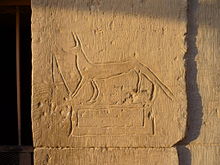
"Graffiti" (usually both singular and plural) and the rare singular form "graffito" are from the Italian discussion graffiato ("scratched").[6] [1] [two] The term "graffiti" is used in art history for works of art produced past scratching a design into a surface. A related term is "sgraffito",[vii] which involves scratching through one layer of pigment to reveal another beneath it. This technique was primarily used by potters who would glaze their wares and and then scratch a blueprint into information technology. In aboriginal times graffiti were carved on walls with a sharp object, although sometimes chalk or coal were used. The word originates from Greek γράφειν —graphein—meaning "to write".[viii]
History

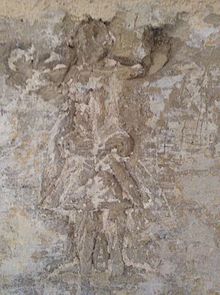
Effigy graffito, similar to a relief, at the Castellania, in Valletta
The term graffiti originally referred to the inscriptions, effigy drawings, and such, found on the walls of aboriginal sepulchres or ruins, equally in the Catacombs of Rome or at Pompeii. Use of the word has evolved to include whatsoever graphics applied to surfaces in a fashion that constitutes vandalism.[9]
The only known source of the Safaitic linguistic communication, an aboriginal form of Standard arabic, is from graffiti: inscriptions scratched on to the surface of rocks and boulders in the predominantly basalt desert of southern Syrian arab republic, eastern Hashemite kingdom of jordan and northern Kingdom of saudi arabia. Safaitic dates from the first century BC to the quaternary century AD.[10] [11]
Mod-style graffiti
The get-go known example of "modernistic style"[ description needed ] graffiti survives in the ancient Greek metropolis of Ephesus (in modernistic-day Turkey). Local guides say it is an advertisement for prostitution. Located near a mosaic and rock walkway, the graffiti shows a handprint that vaguely resembles a center, forth with a footprint, a number, and a carved image of a woman'due south caput.
The ancient Romans carved graffiti on walls and monuments, examples of which too survive in Egypt. Graffiti in the classical world had different connotations than they conduct in today's lodge concerning content. Ancient graffiti displayed phrases of love declarations, political rhetoric, and simple words of thought, compared to today's popular letters of social and political ethics.[12] The eruption of Vesuvius preserved graffiti in Pompeii, which includes Latin curses, magic spells, declarations of love, insults, alphabets, political slogans, and famous literary quotes, providing insight into aboriginal Roman street life. One inscription gives the accost of a woman named Novellia Primigenia of Nuceria, a prostitute, plainly of great beauty, whose services were much in demand. Another shows a phallus accompanied by the text, mansueta tene ("handle with care").
Disappointed love also constitute its way onto walls in artifact:
Quisquis amat. veniat. Veneri volo frangere costas
fustibus et lumbos debilitare deae.
Si potest illa mihi tenerum pertundere pectus
quit ego non possim caput illae frangere fuste?Whoever loves, get to hell. I desire to intermission Venus's ribs
with a order and deform her hips.
If she can intermission my tender heart
why can't I hit her over the caput?— CIL IV, 1824.[xiii]
Ancient tourists visiting the 5th-century citadel at Sigiriya in Sri Lanka scribbled over 1800 individual graffiti there betwixt the 6th and 18th centuries. Etched on the surface of the Mirror Wall, they contain pieces of prose, poetry, and commentary. The majority of these visitors appear to have been from the elite of society: royalty, officials, professions, and clergy. At that place were as well soldiers, archers, and even some metalworkers. The topics range from love to satire, curses, wit, and complaining. Many demonstrate a very loftier level of literacy and a deep appreciation of art and poesy.[14] Near of the graffiti refer to the frescoes of semi-nude females found there. 1 reads:
Moisture with absurd dew drops
fragrant with perfume from the flowers
came the gentle breeze
jasmine and water lily
dance in the jump sunshine
side-long glances
of the golden-hued ladies
stab into my thoughts
heaven itself cannot take my mind
equally it has been captivated by one lass
among the 5 hundred I have seen here.[fifteen]
Among the ancient political graffiti examples were Arab satirist poems. Yazid al-Himyari, an Umayyad Arab and Persian poet, was almost known for writing his political poetry on the walls betwixt Sajistan and Basra, manifesting a strong hatred towards the Umayyad regime and its walis, and people used to read and circulate them very widely.[16] [ clarification needed ]
Level of literacy often evident in graffiti
Historic forms of graffiti take helped proceeds understanding into the lifestyles and languages of past cultures. Errors in spelling and grammar in these graffiti offer insight into the degree of literacy in Roman times and provide clues on the pronunciation of spoken Latin. Examples are CIL IV, 7838: Vettium Firmum / aed[ilem] quactiliar[ii] [sic] rog[pismire]. Hither, "qu" is pronounced "co". The 83 pieces of graffiti constitute at CIL Iv, 4706-85 are evidence of the power to read and write at levels of society where literacy might non be expected. The graffiti announced on a peristyle which was being remodeled at the time of the eruption of Vesuvius by the builder Crescens. The graffiti were left past both the foreman and his workers. The brothel at CIL Vii, 12, 18–20 contains more 120 pieces of graffiti, some of which were the work of the prostitutes and their clients. The gladiatorial academy at CIL IV, 4397 was scrawled with graffiti left by the gladiator Celadus Crescens (Suspirium puellarum Celadus thraex: "Celadus the Thracian makes the girls sigh.")
Another piece from Pompeii, written on a tavern wall about the possessor of the establishment and his questionable wine:
Landlord, may your lies malign
Bring destruction on your caput!
You lot yourself potable unmixed wine,
Water [do you] sell [to] your guests instead.[17]
It was non only the Greeks and Romans who produced graffiti: the Maya site of Tikal in Republic of guatemala contains examples of ancient Maya graffiti. Viking graffiti survive in Rome and at Newgrange Mound in Ireland, and a Varangian scratched his proper name (Halvdan) in runes on a banister in the Hagia Sophia at Constantinople. These early forms of graffiti accept contributed to the agreement of lifestyles and languages of past cultures.
Graffiti, known every bit Tacherons, were frequently scratched on Romanesque Scandinavian church building walls.[18] When Renaissance artists such as Pinturicchio, Raphael, Michelangelo, Ghirlandaio, or Filippino Lippi descended into the ruins of Nero'due south Domus Aurea, they carved or painted their names and returned to initiate the grottesche mode of ornamentation.[19] [xx]
There are also examples of graffiti occurring in American history, such as Independence Rock, a national landmark along the Oregon Trail.[21]
After, French soldiers carved their names on monuments during the Napoleonic campaign of Arab republic of egypt in the 1790s.[22] Lord Byron'due south survives on one of the columns of the Temple of Poseidon at Cape Sounion in Attica, Greece.[23]
- Ancient graffiti
-

Ironic wall inscription commenting on tiresome graffiti
-

-

-

Crusader graffiti in the Church building of the Holy Sepulchre
-

-

Contemporary graffiti
Contemporary graffiti style has been heavily influenced by hip hop civilization[24] and the myriad international styles derived from Philadelphia and New York City Subway graffiti, however, there are many other traditions of notable graffiti in the twentieth century. Graffiti have long appeared on building walls, in latrines, railroad boxcars, subways, and bridges.
The oldest known example of modern graffiti are the "monikers" found on traincars created by hobos and railworkers since the late 1800s. The Bozo Texino monikers were documented by filmmaker Pecker Daniel in his 2005 film, Who is Bozo Texino?.[25] [26]
Some graffiti have their ain poignancy. In World War II, an inscription on a wall at the fortress of Verdun was seen as an illustration of the The states response twice in a generation to the wrongs of the One-time Earth:[27] [28]
Austin White – Chicago, Sick – 1918
Austin White – Chicago, Ill – 1945
This is the last time I want to write my name here.
During World War II and for decades later on, the phrase "Kilroy was hither" with an accompanying illustration was widespread throughout the world, due to its apply by American troops and ultimately filtering into American pop culture. Shortly later on the decease of Charlie Parker (nicknamed "Yardbird" or "Bird"), graffiti began appearing effectually New York with the words "Bird Lives".[29] The pupil protests and general strike of May 1968 saw Paris bedecked in revolutionary, anarchistic, and situationist slogans such as L'ennui est contre-révolutionnaire ("Colorlessness is counterrevolutionary") expressed in painted graffiti, poster art, and stencil fine art. At the time in the US, other political phrases (such as "Free Huey" well-nigh Blackness Panther Huey Newton) became briefly popular as graffiti in limited areas, only to be forgotten. A popular graffito of the early 1970s was "Dick Nixon Before He Dicks You", reflecting the hostility of the youth civilization to that US president.
- World War 2 graffiti
-

Soldier with tropical fantasy graffiti (1943–1944)
-

Advent of droplets paint
Rock and curlicue graffiti is a significant subgenre. A famous graffito of the twentieth century was the inscription in the London tube reading "Clapton is God" in a link to the guitarist Eric Clapton. The phrase was spray-painted past an admirer on a wall in an Islington station on the Underground in the fall of 1967. The graffito was captured in a photograph, in which a dog is urinating on the wall.
Graffiti also became associated with the anti-establishment punk stone movement offset in the 1970s. Bands such as Blackness Flag and Crass (and their followers) widely stenciled their names and logos, while many punk dark clubs, squats, and hangouts are famous for their graffiti. In the tardily 1980s the upside down Martini glass that was the tag for punk band Missing Foundation was the most ubiquitous graffito in lower Manhattan[ according to whom? ]
- Early spray-painted graffiti
-
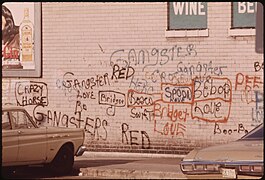
Graffiti in Chicago (1973)
Spread of hip hop culture
Style Wars depicted not just famous graffitists such as Skeme, Dondi, MinOne, and ZEPHYR, but also reinforced graffiti's role within New York's emerging hip-hop civilisation past incorporating famous early pause-dancing groups such as Rock Steady Coiffure into the pic and featuring rap in the soundtrack. Although many officers of the New York City Police Section found this film to be controversial, Way Wars is even so recognized as the most prolific film representation of what was going on within the young hip hop civilization of the early 1980s.[30] Fabfive Freddy and Futura 2000 took hip hop graffiti to Paris and London as part of the New York City Rap Tour in 1983.[31]
Stencil graffiti emerges
This period besides saw the emergence of the new stencil graffiti genre. Some of the first examples were created in 1981 past graffitists Blek le Rat in Paris, in 1982 by Jef Aerosol in Tours (France);[ citation needed ] by 1985 stencils had appeared in other cities including New York Metropolis, Sydney, and Melbourne, where they were documented by American photographer Charles Gatewood and Australian photographer Rennie Ellis.[32]
Commercialization and entrance into mainstream popular culture
With the popularity and legitimization of graffiti has come a level of commercialization. In 2001, computer behemothic IBM launched an advertisement campaign in Chicago and San Francisco which involved people spray painting on sidewalks a peace symbol, a heart, and a penguin (Linux mascot), to represent "Peace, Love, and Linux." IBM paid Chicago and San Francisco collectively US$120,000 for punitive damages and make clean-up costs.[33] [34]
In 2005, a like advertising campaign was launched by Sony and executed by its advertising bureau in New York, Chicago, Atlanta, Philadelphia, Los Angeles, and Miami, to market place its handheld PSP gaming system. In this campaign, taking notice of the legal issues of the IBM entrada, Sony paid building owners for the rights to pigment on their buildings "a collection of light-headed-eyed urban kids playing with the PSP as if information technology were a skateboard, a paddle, or a rocking horse".[34]
Advocates
Marc Ecko, an urban clothing designer, has been an advocate of graffiti as an art course during this period, stating that "Graffiti is without question the about powerful art movement in recent history and has been a driving inspiration throughout my career."[35]
Graffiti have become a common stepping rock for many members of both the fine art and design communities in North America and abroad. Inside the United states of america graffitists such as Mike Behemothic, Pursue, Rime, Noah, and countless others take made careers in skateboard, apparel, and shoe design for companies such as DC Shoes, Adidas, Rebel8, Osiris, or Circa[36] Meanwhile, at that place are many others such equally DZINE, Daze, Blade, and The Mac who have fabricated the switch to being gallery artists, often not even using their initial medium, spray paint.[36]
Global developments
South America
Tristan Manco wrote that Brazil "boasts a unique and particularly rich, graffiti scene ... [earning] it an international reputation as the place to go for artistic inspiration." Graffiti "flourishes in every conceivable space in Brazil's cities." Artistic parallels "are frequently fatigued between the energy of São Paulo today and 1970s New York." The "sprawling city," of São Paulo has "become the new shrine to graffiti;" Manco alludes to "poverty and unemployment ... [and] the epic struggles and weather condition of the country's marginalised peoples," and to "Brazil's chronic poverty," as the main engines that "have fuelled a vibrant graffiti culture." In world terms, Brazil has "one of the most uneven distributions of income. Laws and taxes change oftentimes." Such factors, Manco argues, contribute to a very fluid club, riven with those economic divisions and social tensions that underpin and feed the "folkloric vandalism and an urban sport for the disenfranchised," that is South American graffiti art.[37]

A graffiti piece plant in Tel Aviv by the creative person DeDe
Prominent Brazilian graffitists include Os Gêmeos, Boleta, Nunca, Nina, Speto, Tikka, and T.Freak.[38] Their artistic success and interest in commercial design ventures[39] has highlighted divisions within the Brazilian graffiti community between adherents of the cruder transgressive course of pichação and the more conventionally artistic values of the practitioners of grafite.[forty]
Eye East
Graffiti in the Heart East has emerged slowly, with taggers operating in Egypt, Lebanon, the Gulf countries like Bahrein or the United Arab Emirates,[41] Israel, and in Islamic republic of iran. The major Iranian newspaper Hamshahri has published two articles on illegal writers in the city with photographic coverage of Iranian creative person A1one's works on Tehran walls. Tokyo-based design magazine, PingMag, has interviewed A1one and featured photographs of his piece of work.[42] The Israeli Westward Banking company barrier has become a site for graffiti, reminiscent in this sense of the Berlin Wall. Many graffitists in State of israel come from other places around the globe, such as JUIF from Los Angeles and DEVIONE from London. The religious reference "נ נח נחמ נחמן מאומן" ("Na Nach Nachma Nachman Meuman") is normally seen in graffiti around Israel.
Graffiti has played an important part within the street art scene in the Eye E and North Africa (MENA), especially following the events of the Arab Spring of 2011 or the Sudanese Revolution of 2018/19.[43] Graffiti is a tool of expression in the context of conflict in the region, allowing people to raise their voices politically and socially. Famous street artist Banksy has had an of import effect in the street art scene in the MENA area, particularly in Palestine where some of his works are located in the West Bank barrier and Bethlehem.[44]
Southeast Asia
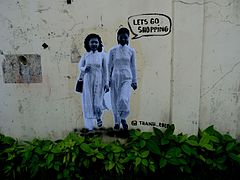
There are likewise a large number of graffiti influences in Southeast Asian countries that mostly come from mod Western culture, such as Malaysia, where graffiti have long been a mutual sight in Malaysia'southward capital letter city, Kuala Lumpur. Since 2010, the land has begun hosting a street festival to encourage all generations and people from all walks of life to bask and encourage Malaysian street culture.[45]
- Graffiti effectually the globe
-
-

-
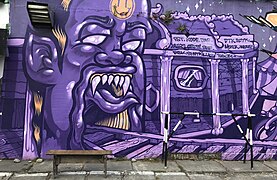
Characteristics of common graffiti
Methods and production
The modern-twenty-four hour period graffitists can be institute with an arsenal of various materials that allow for a successful production of a piece.[46] This includes such techniques as scribing. Notwithstanding, spray paint in aerosol cans is the number one medium for graffiti. From this article comes different styles, technique, and abilities to form master works of graffiti. Spray pigment can be found at hardware and art stores and comes in virtually every color.
Stencil graffiti is created by cutting out shapes and designs in a potent material (such as cardboard or discipline folders) to form an overall design or image. The stencil is and so placed on the "canvas" gently and with quick, like shooting fish in a barrel strokes of the aerosol can, the image begins to appear on the intended surface.
- Graffiti making
-
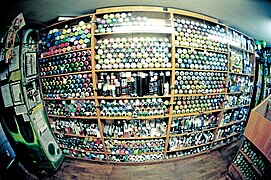
The first graffiti shop in Russia was opened in 1992 in Tver
-

Graffiti application at Eurofestival in Turku, Finland
-

Graffiti application in India using natural pigments (mostly charcoal, plant saps, and dirt)
-
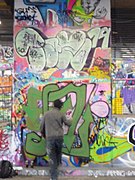
A graffiti creative person at work in London
Modern experimentation

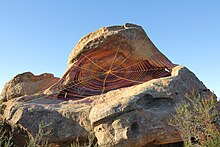
Spiderweb Yarnbomb Installation by Stephen Duneier both hides and highlights previous graffiti.
Modernistic graffiti art ofttimes incorporates additional arts and technologies. For case, Graffiti Research Lab has encouraged the use of projected images and magnetic calorie-free-emitting diodes (throwies) every bit new media for graffitists. Yarnbombing is another recent form of graffiti. Yarnbombers occasionally target previous graffiti for modification, which had been avoided among the bulk of graffitists.
Tagging
Tagging is the practice of someone spray-painting "their proper name, initial or logo onto a public surface".[47]
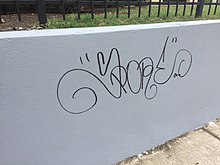
A tag in Dallas, reading "Spore"
A number of recent examples of graffiti brand apply of hashtags.[48] [49]

Densely-tagged parking area in Århus, Denmark
Uses
Theories on the use of graffiti by avant-garde artists have a history dating back at least to the Asger Jorn, who in 1962 painting declared in a graffiti-similar gesture "the avant-garde won't give upward".[l]
Many contemporary analysts and even art critics have begun to see creative value in some graffiti and to recognize information technology every bit a form of public fine art. According to many art researchers, peculiarly in kingdom of the netherlands and in Los Angeles, that type of public art is, in fact an effective tool of social emancipation or, in the achievement of a political goal.[51]
In times of conflict, such murals have offered a means of advice and self-expression for members of these socially, ethnically, or racially divided communities, and have proven themselves as effective tools in establishing dialog and thus, of addressing cleavages in the long run. The Berlin Wall was also extensively covered past graffiti reflecting social pressures relating to the oppressive Soviet rule over the Gdr.
Many artists involved with graffiti are as well concerned with the like activity of stenciling. Essentially, this entails stenciling a impress of one or more colors using spray-paint. Recognized while exhibiting and publishing several of her coloured stencils and paintings portraying the Sri Lankan Civil War and urban Great britain in the early 2000s, graffitists Mathangi Arulpragasam, aka M.I.A., has as well become known for integrating her imagery of political violence into her music videos for singles "Galang" and "Bucky Done Gun", and her cover art. Stickers of her artwork also often appear around places such as London in Brick Lane, stuck to lamp posts and street signs, she having become a muse for other graffitists and painters worldwide in cities including Seville.
Personal expression
Many graffitists choose to protect their identities and remain anonymous or to hinder prosecution.
With the commercialization of graffiti (and hip hop in full general), in most cases, even with legally painted "graffiti" art, graffitists tend to cull anonymity. This may be attributed to various reasons or a combination of reasons. Graffiti all the same remains the ane of four hip hop elements that is not considered "performance fine art" despite the prototype of the "singing and dancing star" that sells hip hop culture to the mainstream. Being a graphic class of fine art, it might also exist said that many graffitists notwithstanding fall in the category of the introverted archetypal artist.
Banksy is ane of the world's almost notorious and popular street artists who continues to remain faceless in today's society.[52] He is known for his political, anti-war stencil art mainly in Bristol, England, only his work may be seen anywhere from Los Angeles to Palestine. In the UK, Banksy is the almost recognizable icon for this cultural artistic movement and keeps his identity a clandestine to avert abort. Much of Banksy'south artwork may be seen around the streets of London and surrounding suburbs, although he has painted pictures throughout the world, including the Heart East, where he has painted on State of israel'south controversial Due west Banking company barrier with satirical images of life on the other side. I depicted a hole in the wall with an idyllic beach, while some other shows a mountain landscape on the other side. A number of exhibitions too have taken place since 2000, and recent works of art have fetched vast sums of coin. Banksy's art is a prime case of the archetype controversy: vandalism vs. art. Art supporters endorse his work distributed in urban areas equally pieces of fine art and some councils, such every bit Bristol and Islington, have officially protected them, while officials of other areas have deemed his work to be vandalism and take removed information technology.
Pixnit is another artist who chooses to keep her identity from the general public.[53] Her piece of work focuses on beauty and design aspects of graffiti as opposed to Banksy's anti-government shock value. Her paintings are often of flower designs higher up shops and stores in her local urban area of Cambridge, Massachusetts. Some shop owners endorse her piece of work and encourage others to do like work as well. "One of the pieces was left up above Steve's Kitchen, because information technology looks pretty awesome"- Erin Scott, the manager of New England Comics in Allston, Massachusetts.[54]
Graffiti artists may become offended if photographs of their fine art are published in a commercial context without their permission. In March 2020, the Finnish graffiti creative person Psyke expressed his displeasure at the newspaper Ilta-Sanomat publishing a photograph of a Peugeot 208 in an article virtually new cars, with his graffiti prominently shown on the groundwork. The artist claims he does not want his art being used in commercial context, not even if he were to receive compensation.[55]
- Personal graffiti
-

Inscription in Pompeii lamenting a frustrated love, "Whoever loves, let him flourish, permit him perish who knows not love, let him perish twice over whoever forbids love."
-

-
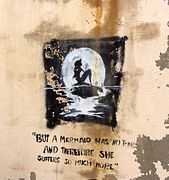
Radical and political

Graffiti often has a reputation as function of a subculture that rebels against authority, although the considerations of the practitioners often diverge and can relate to a wide range of attitudes. It can express a political practice and tin can form just one tool in an assortment of resistance techniques. 1 early example includes the anarcho-punk band Crass, who conducted a campaign of stenciling anti-state of war, agitator, feminist, and anti-consumerist messages throughout the London Hush-hush arrangement during the tardily 1970s and early 1980s.[56] In Amsterdam graffiti was a major part of the punk scene. The city was covered with names such as "De Zoot", "Vendex", and "Dr Rat".[57] To document the graffiti a punk magazine was started that was called Gallery Anus. And so when hip hop came to Europe in the early 1980s there was already a vibrant graffiti culture.

The student protests and full general strike of May 1968 saw Paris bedecked in revolutionary, anarchistic, and situationist slogans such as L'ennui est contre-révolutionnaire ("Boredom is counterrevolutionary") and Lisez moins, vivez plus ("Read less, live more than"). While not exhaustive, the graffiti gave a sense of the 'millenarian' and rebellious spirit, tempered with a good deal of verbal wit, of the strikers.
I retrieve graffiti writing is a way of defining what our generation is like. Excuse the French, we're not a agglomeration of p---- artists. Traditionally artists have been considered soft and mellow people, a little bit kooky. Maybe we're a piffling scrap more like pirates that manner. We defend our territory, whatever space we steal to pigment on, we defend it fiercely.
—Sandra "Lady Pinkish" Fabara[58]
The developments of graffiti art which took identify in art galleries and colleges besides as "on the street" or "underground", contributed to the resurfacing in the 1990s of a far more overtly politicized art form in the subvertising, culture jamming, or tactical media movements. These movements or styles tend to allocate the artists past their relationship to their social and economic contexts, since, in most countries, graffiti art remains illegal in many forms except when using non-permanent paint. Since the 1990s with the rising of Street Fine art, a growing number of artists are switching to non-permanent paints and not-traditional forms of painting.[59] [60]
Contemporary practitioners, accordingly, take varied and often conflicting practices. Some individuals, such every bit Alexander Brener, take used the medium to politicize other fine art forms, and have used the prison sentences enforced on them as a ways of further protest.[61] The practices of anonymous groups and individuals likewise vary widely, and practitioners by no means always agree with each other's practices. For example, the anti-capitalist fine art group the Space Hijackers did a piece in 2004 virtually the contradiction between the capitalistic elements of Banksy and his use of political imagery.[62] [63]
Berlin human rights activist Irmela Mensah-Schramm has received global media attention and numerous awards for her 35-yr campaign of effacing neo-Nazi and other correct-wing extremist graffiti throughout Federal republic of germany, ofttimes by altering detest speech in humorous ways.[64] [65]

Territorial
Territorial graffiti marks urban neighborhoods with tags and logos to differentiate certain groups from others. These images are meant to show outsiders a stern expect at whose turf is whose. The subject area matter of gang-related graffiti consists of ambiguous symbols and initials strictly fashioned with unique calligraphies. Gang members use graffiti to designate membership throughout the gang, to differentiate rivals and assembly and, almost commonly, to marking borders which are both territorial and ideological.[66]
Gallery
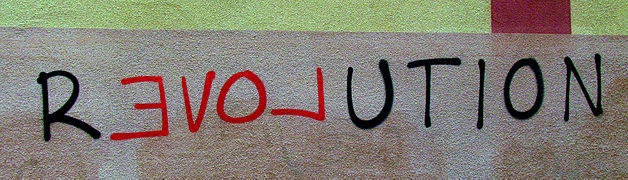
- Political graffiti around the globe
-
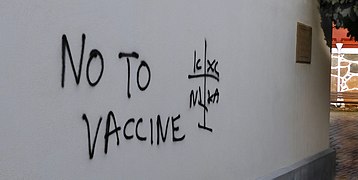
Graffiti with orthodox cross at the Catholic Church building in Ystad 2021.
-
-

Anti Iraqi war graffiti by street artist Sony Montana in Cancun, United mexican states (2007)
-

WWII bunker near Anhalter Bahnhof (Berlin) with a graffiti inscription Wer Bunker baut, wirft Bomben (those who build bunkers, throw bombs)
-

Graffiti on the train line leading to Central Station in Amsterdam
-

Stencil in Pieksämäki representing former president of Finland, Urho Kekkonen, well known in Finnish pop civilisation
-

Berlin Wall: "Anyone who wants to continue the world as information technology is, does not want information technology to remain"
As ad
Graffiti has been used as a means of advertising both legally and illegally. Bronx-based TATS CRU has made a proper name for themselves doing legal advertizement campaigns for companies such as Coca-Cola, McDonald'due south, Toyota, and MTV. In the UK, Covent Garden's Boxfresh used stencil images of a Zapatista revolutionary in the hopes that cross referencing would promote their shop.
Smirnoff hired artists to utilize reverse graffiti (the utilise of high pressure hoses to clean muddied surfaces to go out a clean paradigm in the surrounding clay) to increase awareness of their production.
- Advertising graffiti
-

Graffiti as advertising in Haikou, Hainan Province, China, which is an extremely common form of graffiti seen throughout the country
-

Graffiti as legal ad on a grocer's store window in Warsaw, Poland
Offensive graffiti

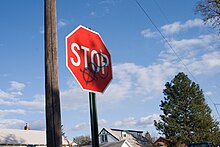
Graffiti may also exist used as an offensive expression. This form of graffiti may exist difficult to identify, as it is mostly removed by the local authority (equally councils which take adopted strategies of criminalization also strive to remove graffiti quickly).[67] Therefore, existing racist graffiti is mostly more subtle and at first sight, not easily recognized equally "racist". Information technology tin then be understood just if i knows the relevant "local code" (social, historical, political, temporal, and spatial), which is seen as heteroglot and thus a 'unique set of conditions' in a cultural context.[68]
- A spatial lawmaking for instance, could exist that there is a sure youth grouping in an area that is engaging heavily in racist activities. So, for residents (knowing the local code), a graffiti containing only the name or abridgement of this gang already is a racist expression, reminding the offended people of their gang activities. Also a graffiti is in virtually cases, the herald of more serious criminal activity to come.[69] A person who does not know these gang activities would non exist able to recognize the significant of this graffiti. Also if a tag of this youth group or gang is placed on a building occupied by asylum seekers, for example, its racist character is even stronger.
By making the graffiti less explicit (as adapted to social and legal constraints),[70] these drawings are less probable to be removed, but do not lose their threatening and offensive grapheme.[71]
Elsewhere, activists in Russia accept used painted caricatures of local officials with their mouths as potholes, to evidence their anger well-nigh the poor state of the roads.[72] In Manchester, England a graffitists painted obscene images around potholes, which ofttimes resulted in their being repaired within 48 hours.[73]
Decorative and high art
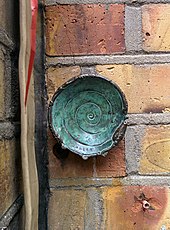
A bronze work by Jonesy on a wall in Brick Lane (London). Bore well-nigh 8 cm.
In the early on 1980s, the offset art galleries to show graffitists to the public were Fashion Moda in the Bronx, At present Gallery and Fun Gallery, both in the East Village, Manhattan.[74] [75] [76] [77]
A 2006 exhibition at the Brooklyn Museum displayed graffiti as an fine art form that began in New York'due south outer boroughs and reached great heights in the early on 1980s with the work of Crash, Lee, Daze, Keith Haring, and Jean-Michel Basquiat. Information technology displayed 22 works past New York graffitists, including Crash, Daze, and Lady Pink. In an commodity about the exhibition in the magazine Time Out, curator Charlotta Kotik said that she hoped the exhibition would cause viewers to rethink their assumptions most graffiti.
From the 1970s onwards, Burhan Dogancay photographed urban walls all over the world; these he and so archived for use as sources of inspiration for his painterly works. The project today known as "Walls of the Earth" grew across fifty-fifty his ain expectations and comprises about 30,000 individual images. It spans a period of 40 years across v continents and 114 countries. In 1982, photographs from this projection comprised a one-homo exhibition titled "Les murs murmurent, ils crient, ils chantent..." (The walls whisper, shout and sing...) at the Centre Georges Pompidou in Paris.
In Australia, fine art historians have judged some local graffiti of sufficient creative merit to rank them firmly within the arts. Oxford University Printing'southward art history text Australian Painting 1788–2000 concludes with a long discussion of graffiti's key identify inside contemporary visual culture, including the work of several Australian practitioners.[78]
Between March and April 2009, 150 artists exhibited 300 pieces of graffiti at the Thou Palais in Paris.[79] [lxxx]
- Street art graffiti
Environmental effects
Spray paint has many negative environmental effects. The paint contains toxic chemicals, and the tin uses volatile hydrocarbon gases to spray the pigment onto a surface.[81]
Volatile organic compound (VOC) leads to footing level ozone formation and nearly of graffiti related emissions are VOCs.[82] A 2010 newspaper estimates 4,862 tons of VOCs were released in the Us in activities related to graffiti.[82] [83]
Authorities responses
Asia
In People's republic of china, Mao Zedong in the 1920s used revolutionary slogans and paintings in public places to galvanise the land's communist revolution.[84]
Based on different national conditions, many people believe that China's attitude towards Graffiti is vehement, simply in fact, co-ordinate to Lance Crayon in his picture show Spray Paint Beijing: Graffiti in the Uppercase of China, Graffiti is generally accepted in Beijing, with artists not seeing much police interference. Political and religiously sensitive graffiti, all the same, is not allowed.[85]
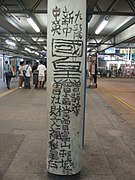
In Hong Kong, Tsang Tsou Choi was known every bit the King of Kowloon for his calligraphy graffiti over many years, in which he claimed ownership of the area. Now some of his work is preserved officially.
In Taiwan, the government has made some concessions to graffitists. Since 2005 they have been immune to freely display their piece of work forth some sections of riverside retaining walls in designated "Graffiti Zones".[86] From 2007, Taipei's department of cultural affairs also began permitting graffiti on fences around major public structure sites. Department head Yong-ping Lee (李永萍) stated, "We will promote graffiti starting with the public sector, and then later in the private sector too. Information technology's our goal to beautify the city with graffiti". The government later helped organize a graffiti competition in Ximending, a pop shopping district. graffitists caught working exterior of these designated areas still face fines up to NT$six,000 under a department of environmental protection regulation.[87] However, Taiwanese regime tin be relatively lenient, one veteran police officer stating anonymously, "Unless someone complains about vandalism, we won't go involved. Nosotros don't go after it proactively."[88]
In 1993, after several expensive cars in Singapore were spray-painted, the police arrested a student from the Singapore American School, Michael P. Fay, questioned him, and subsequently charged him with vandalism. Fay pleaded guilty to vandalizing a car in add-on to stealing route signs. Under the 1966 Vandalism Act of Singapore, originally passed to adjourn the spread of communist graffiti in Singapore, the courtroom sentenced him to four months in jail, a fine of Due south$3,500 (Us$2,233), and a caning. The New York Times ran several editorials and op-eds that condemned the penalisation and called on the American public to flood the Singaporean embassy with protests. Although the Singapore authorities received many calls for clemency, Fay's caning took place in Singapore on five May 1994. Fay had originally received a sentence of six strokes of the cane, but the presiding president of Singapore, Ong Teng Cheong, agreed to reduce his caning sentence to 4 lashes.[89]
In South Korea, Park Jung-soo was fined two million South Korean won by the Seoul Central District Court for spray-painting a rat on posters of the G-20 Pinnacle a few days earlier the event in November 2011. Park declared that the initial in "Yard-xx" sounds like the Korean word for "rat", but Korean government prosecutors declared that Park was making a derogatory argument virtually the president of South korea, Lee Myung-bak, the host of the elevation. This example led to public outcry and argue on the lack of government tolerance and in support of freedom of expression. The courtroom ruled that the painting, "an ominous creature similar a rat" amounts to "an organized criminal activeness" and upheld the fine while denying the prosecution's request for imprisonment for Park.[90]
- Graffiti in Asia
-
-
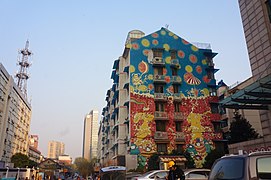
The Graffiti Piece "Tante" (by Chen Dongfan) on the surface wall of an quondam residential building in Hangzhou, Zhejiang
Europe
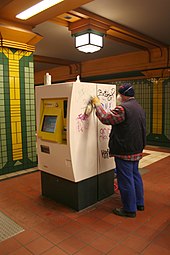
Graffiti removal in Berlin
In Europe, community cleaning squads have responded to graffiti, in some cases with reckless carelessness, as when in 1992 in French republic a local Watch group, attempting to remove mod graffiti, damaged two prehistoric paintings of bison in the Cave of Mayrière supérieure virtually the French hamlet of Bruniquel in Tarn-et-Garonne, earning them the 1992 Ig Nobel Prize in archeology.[91]
In September 2006, the European Parliament directed the European Commission to create urban environment policies to forbid and eliminate dirt, litter, graffiti, animal excrement, and excessive noise from domestic and vehicular music systems in European cities, along with other concerns over urban life.[92]
In Budapest, Hungary, both a urban center-backed movement called I Dear Budapest and a special police force sectionalization tackle the problem, including the provision of approved areas.[93]
United Kingdom
The Anti-Social Behaviour Act 2003 became U.k.'s latest anti-graffiti legislation. In August 2004, the Continue Britain Tidy campaign issued a printing release calling for zero tolerance of graffiti and supporting proposals such every bit issuing "on the spot" fines to graffiti offenders and banning the sale of aerosol paint to anyone under the historic period of 16.[94] The printing release besides condemned the utilise of graffiti images in advertisement and in music videos, arguing that real-world experience of graffiti stood far removed from its often-portrayed "cool" or "edgy'" prototype.
To dorsum the campaign, 123 Members of Parliament (MPs) (including and then Prime Government minister Tony Blair), signed a charter which stated: "Graffiti is not art, information technology's criminal offense. On behalf of my constituents, I will do all I can to rid our community of this problem."[95]
In the Great britain, city councils have the power to take activity against the owner of any property that has been defaced under the Anti-social Behaviour Act 2003 (every bit amended past the Clean Neighbourhoods and Environment Act 2005) or, in certain cases, the Highways Human activity. This is often used confronting owners of property that are complacent in assuasive protective boards to exist defaced so long equally the property is non damaged.[ commendation needed ]
In July 2008, a conspiracy charge was used to convict graffitists for the first fourth dimension. Subsequently a three-month police surveillance operation,[96] nine members of the DPM coiffure were convicted of conspiracy to commit criminal damage costing at least £1 meg. Five of them received prison sentences, ranging from eighteen months to two years. The unprecedented calibration of the investigation and the severity of the sentences rekindled public debate over whether graffiti should be considered art or crime.[97]
Some councils, similar those of Stroud and Loerrach, provide approved areas in the town where graffitists can showcase their talents, including underpasses, motorcar parks, and walls that might otherwise prove a target for the "spray and run".[98]
- Graffiti in Europe
-

Integration of graffiti into its surroundings, Zumaia 2016
Australia
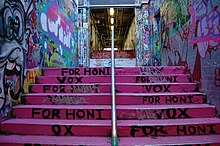
Graffiti Tunnel, University of Sydney at Camperdown (2009)
In an effort to reduce vandalism, many cities in Australia have designated walls or areas exclusively for use by graffitists. One early example is the "Graffiti Tunnel" located at the Camperdown Campus of the University of Sydney, which is available for use by whatsoever student at the university to tag, advertise, poster, and create "fine art". Advocates of this thought suggest that this discourages petty vandalism yet encourages artists to accept their time and produce swell art, without worry of being caught or arrested for vandalism or trespassing.[99] [100] Others disagree with this approach, arguing that the presence of legal graffiti walls does not demonstrably reduce illegal graffiti elsewhere.[101] Some local regime areas throughout Australia accept introduced "anti-graffiti squads", who make clean graffiti in the area, and such crews as BCW (Buffers Can't Win) have taken steps to keep one step ahead of local graffiti cleaners.
Many state governments take banned the sale or possession of spray paint to those under the historic period of eighteen (historic period of majority). However, a number of local governments in Victoria have taken steps to recognize the cultural heritage value of some examples of graffiti, such equally prominent political graffiti. Tough new graffiti laws have been introduced in Australia with fines of upward to A$26,000 and two years in prison.
Melbourne is a prominent graffiti city of Commonwealth of australia with many of its lanes being tourist attractions, such as Hosier Lane in particular, a popular destination for photographers, hymeneals photography, and backdrops for corporate print ad. The Lonely Planet travel guide cites Melbourne'southward street as a major allure. All forms of graffiti, including sticker art, affiche, stencil art, and wheatpasting, can exist found in many places throughout the metropolis. Prominent street art precincts include; Fitzroy, Collingwood, Northcote, Brunswick, St. Kilda, and the CBD, where stencil and sticker art is prominent. As one moves farther away from the urban center, more often than not along suburban train lines, graffiti tags become more prominent. Many international artists such as Banksy accept left their work in Melbourne and in early on 2008 a perspex screen was installed to forbid a Banksy stencil art piece from beingness destroyed, information technology has survived since 2003 through the respect of local street artists avoiding posting over it, although it has recently had pigment tipped over information technology.[102]
New Zealand
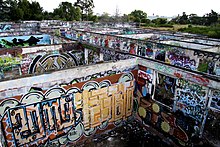
Former Christchurch stock yards
In February 2008 Helen Clark, the New Zealand prime minister at that time, announced a authorities crackdown on tagging and other forms of graffiti vandalism, describing it as a destructive crime representing an invasion of public and private belongings. New legislation afterwards adopted included a ban on the sale of paint spray cans to persons nether xviii and increases in maximum fines for the offence from NZ$200 to NZ$two,000 or extended community service. The issue of tagging become a widely debated one following an incident in Auckland during January 2008 in which a heart-aged property owner stabbed one of two teenage taggers to death and was afterward convicted of manslaughter.
United States
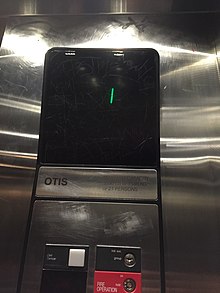
An elevator position indicator with scratch graffiti
Tracker databases
Graffiti databases have increased in the past decade because they let vandalism incidents to be fully documented against an offender and aid the constabulary and prosecution charge and prosecute offenders for multiple counts of vandalism. They likewise provide law enforcement the power to rapidly search for an offender's moniker or tag in a simple, constructive, and comprehensive fashion. These systems can as well help runway costs of impairment to city to assist allocate an anti-graffiti budget. The theory is that when an offender is caught putting up graffiti, they are not just charged with ane count of vandalism; they tin be held answerable for all the other damage for which they are responsible. This has two main benefits for law enforcement. One, it sends a indicate to the offenders that their vandalism is existence tracked. Two, a city can seek restitution from offenders for all the damage that they have committed, non just a single incident. These systems give law enforcement personnel existent-time, street-level intelligence that allows them not only to focus on the worst graffiti offenders and their harm, but besides to monitor potential gang violence that is associated with the graffiti.[103]
Gang injunctions
Many restrictions of civil gang injunctions are designed to help address and protect the physical surround and limit graffiti. Provisions of gang injunctions include things such every bit restricting the possession of mark pens, spray paint cans, or other sharp objects capable of defacing private or public property; spray painting, or marking with mark pens, scratching, applying stickers, or otherwise applying graffiti on any public or private property, including, but non limited to the street, alley, residences, block walls, and fences, vehicles or whatever other real or personal belongings. Some injunctions contain wording that restricts damaging or vandalizing both public and individual property, including but non limited to any vehicle, light fixture, door, debate, wall, gate, window, building, street sign, utility box, telephone box, tree, or ability pole.[104]
Hotlines and reward programs
To help address many of these bug, many local jurisdictions have fix up graffiti abatement hotlines, where citizens can call in and report vandalism and have it removed. San Diego's hotline receives more than v,000 calls per year, in addition to reporting the graffiti, callers can learn more than about prevention. One of the complaints most these hotlines is the response time; there is oft a lag fourth dimension between a property owner calling about the graffiti and its removal. The length of delay should be a consideration for any jurisdiction planning on operating a hotline. Local jurisdictions must convince the callers that their complaint of vandalism will exist a priority and cleaned off right abroad. If the jurisdiction does not have the resource to respond to complaints in a timely manner, the value of the hotline diminishes. Crews must exist able to reply to private service calls fabricated to the graffiti hotline as well as focus on cleanup well-nigh schools, parks, and major intersections and transit routes to have the biggest bear on. Some cities offer a advantage for information leading to the arrest and prosecution of suspects for tagging or graffiti related vandalism. The amount of the reward is based on the information provided, and the activity taken.[105]
Search warrants
When police obtain search warrants in connection with a vandalism investigation, they are often seeking judicial approval to look for items such every bit cans of spray paint and nozzles from other kinds of aerosol sprays; etching tools, or other sharp or pointed objects, which could exist used to etch or scratch drinking glass and other hard surfaces; permanent marking pens, markers, or pigment sticks; evidence of membership or amalgamation with any gang or tagging crew; paraphernalia including any reference to "(tagger's proper noun)"; whatsoever drawings, writing, objects, or graffiti depicting taggers' names, initials, logos, monikers, slogans, or any mention of tagging crew membership; and whatsoever newspaper clippings relating to graffiti criminal offense.[106]
- Graffiti in the Us
-

Rampant graffiti hampers visibility into and out of subway cars (1973)
-

Documentaries
- eighty Blocks from Tiffany's (1979): A rare glimpse into late 1970s New York toward the end of the infamous South Bronx gangs, the documentary shows many sides of the mainly Puerto Rican community of the South Bronx, including reformed gang members, current gang members, the constabulary, and the community leaders who try to reach out to them.
- Stations of the Elevated (1980), the earliest documentary near subway graffiti in New York City, with music by Charles Mingus
- Style Wars (1983), an early documentary on hip hop culture, made in New York City
- Piece by Piece (2005), a feature-length documentary on the history of San Francisco graffiti from the early on 1980s
- Infamy (2005), a characteristic-length documentary about graffiti culture as told through the experiences of six well-known graffiti writers and a graffiti buffer
- Next: A Primer on Urban Painting (2005), a documentary virtually global graffiti culture
- RASH (2005), a characteristic documentary almost Melbourne, Australia and the artists who brand it a living host for street art
- Jisoe (2007): A glimpse into the life of a Melbourne, Commonwealth of australia, graffiti writer shows the audience an case of graffiti in struggling Melbourne Areas.
- Roadsworth: Crossing the Line (2009), about Montréal artist Peter Gibson and his controversial stencil art on public roads
- Exit Through The Gift Shop (2010) was produced by the notorious creative person Banksy. It tells the story of Thierry Guetta, a French immigrant in Los Angeles, and his obsession with street art; Shepard Fairey and Invader, whom Guetta discovers is his cousin, are also in the moving-picture show.
- All the same on and non the wiser (2011) is a ninety-minute-long documentation that accompanies the exhibition with the same name in the Kunsthalle Barmen of the Von der Heydt-Museum in Wuppertal (Deutschland). It draws vivid portrayals of the artists past ways of very personal interviews and also catches the cosmos process of the works earlier the exhibition was opened.[107]
- Graffiti Wars (2011), a documentary detailing King Robbo's feud with Banksy as well every bit the authorities' differing attitude towards graffiti and street art[108]
Dramas
- Wild Style (1983), about hip hop and graffiti culture in New York Urban center
- Turk 182 (1985), well-nigh graffiti equally political activism
- Flop the System (2002), about a coiffure of graffitists in modern-day New York City
- Quality of Life (2004) was shot in the Mission Commune of San Francisco, co-written by and starring a retired graffiti writer.
- Wholetrain (2006), a German pic
See also
- Anti-graffiti coating
- BUGA UP
- Calligraffiti
- The Faith of Graffiti
- Grafedia
- Graffiti abatement
- Graffiti in Miami
- Graffiti in the United Kingdom
- Graffiti post-2011 Egyptian Revolution
- Graffiti terminology
- Hobo sign
- Kilroy was hither
- Kotwica
- Latrinalia
- List of graffiti and street art injuries and deaths
- Monsters of Fine art
- Philadelphia Mural Arts Program
- Roman graffiti
- Spray pigment fine art
- Stencil Graffiti
- Street art
- Vandalism
- Visual pollution
- Yarn bombing
References
- ^ a b "Graffiti". Oxford Dictionaries. Retrieved 5 Dec 2011.
- ^ a b American Heritage Dictionary
- ^ "Graffito". Oxford English language Dictionary. Vol. 2. Oxford Academy Press. 2006.
- ^ "Why Gang Graffiti Is Unsafe—Los Angeles Police Department". www.lapdonline.org. Archived from the original on twenty February 2018. Retrieved 19 February 2018.
- ^ Caves, R. W. (2004). Encyclopedia of the Urban center. Routledge. p. 315.
- ^ The Italian singular grade "graffito" is and then rare in English (except in specialist texts on archeology) that it is not fifty-fifty recorded or mentioned in some dictionaries, for example the Longman Dictionary of Contemporary English language and the Cambridge Advanced Learner's Lexicon.
- ^ Grant, Alison (1983). Due north Devon Pottery: The Seventeenth Century. University of Exeter Press. pp. one–2.
- ^ "graffiti | Origin and meaning of graffiti by Online Etymology Dictionary". world wide web.etymonline.com . Retrieved 19 Feb 2018.
- ^ "How Old Is Graffiti?". Wonderopolis . Retrieved 24 Jan 2017.
- ^ dan. "Ancient Arabia: Languages and Cultures—Safaitic Database Online". krc2.orient.ox.air conditioning.uk. Archived from the original on 20 February 2018. Retrieved 19 February 2018.
- ^ dan. "The Online Corpus of the Inscriptions of Ancient N Arabia—Safaitic". krc.orient.ox.air-conditioning.united kingdom of great britain and northern ireland. Archived from the original on 20 February 2018. Retrieved xix February 2018.
- ^ Ancelet, Jeanine (2006). "The history of graffiti". UCL — London's Global University. Retrieved 20 April 2009.
- ^ CIL Iv, 4200 shows a failed attempt to write this piddling poem, maybe because the writer forgot the verses: encounter Todd, F. A. (1939). "Three Pompeian Wall-Inscriptions, and Petronius". The Classical Review. 53 (i): 5–9. doi:x.1017/S0009840X00088211. JSTOR 706251. page 6 note 2 and Bretschneider, 50'Erma di (1990). Att Återupptäcka Pompeji. ISBN9788870626865. page 39 note 85.
- ^ Ponnamperuma, Senani (2013). Story of Sigiriya. Melbourne, Commonwealth of australia: Panique Pty Ltd. p. 157. ISBN9780987345110.
- ^ Paranavithana, Senarath (1956). Sigiri Graffiti; Beingness Sinhalese Verses of the Eighth, Ninth and Tenth Centuries. London: Govt. of Ceylon by Oxford UP.
- ^ حسين مروّة، تراثنا كيف نعرفه، مؤسسة الأبحاث العربية، بيروت، 1986[ description needed ]
- ^ Olmert, Michael (1996). Milton's Teeth and Ovid'south Umbrella: Curiouser & Curiouser Adventures in History . Simon & Schuster, New York. pp. 48–49. ISBN978-0684801643.
- ^ "Tacherons on Romanesque churches" (PDF).
- ^ British Archæology, June 1999
- ^ "Underground Rome". The Atlantic Monthly. April 1997.
- ^ "Independence Rock—California National Celebrated Trail (National Park Service)". National Park Service. Retrieved xviii January 2018.
- ^ "Art Crimes". Jinx Mag. Archived from the original on fourteen Oct 2014.
- ^ Shanks, Michael (1996). Classical Archaeology of Greece: Experiences of the Subject . London, New York: Routledge. p. 76. ISBN978-0-415-08521-2.
- ^ Edwards, Paul (ten February 2015). "Is Graffiti Really An Element Of Hip-Hop? (volume extract)". The Concise Guide to Hip-Hop Music . Retrieved 23 Baronial 2018.
- ^ Daniel, Bill (22 July 2010). "Who Is Bozo Texino?". Retrieved 23 August 2018.
- ^ Daniel, Bill (2005). "Who Is Bozo Texino?". Who Is Bozo Texino? The Secret History of Hobo Graffiti . Retrieved 23 Baronial 2018.
- ^ Reagan, Geoffrey (1992). War machine Anecdotes (1992). Guinness Publishing. p. 33. ISBN978-0-85112-519-0.
- ^ "Words From a War". The New York Times. 14 Baronial 1985. Retrieved 2 January 2017.
- ^ Russell, Ross. Bird Lives!: The High Life And Hard Times Of Charlie (yardbird) Parker. Da Capo Press.
- ^ Labonte, Paul. All City: The book almost taking infinite. Toronto. ECW Printing. 2003
- ^ David Hershkovits, "London Rocks, Paris Burns and the B-Boys Break a Leg", Dominicus News Mag, 3 April 1983.
- ^ Ellis, Rennie (1985). The All New Australian Graffiti. Sun Books, Melbourne. ISBN978-0-7251-0484-9.
- ^ Niccolai, James (19 Apr 2001). "IBM's graffiti ads run afoul of metropolis officials". CNN. Archived from the original on iv October 2006. Retrieved xi October 2006.
- ^ a b "Sony Draws Ire With PSP Graffiti". Wired. 5 December 2005. Retrieved 8 April 2008.
- ^ "Marc Ecko Hosts "Getting Upward" Block Party For NYC Graffiti, Merely Mayor Is A Hater". SOHH.com. 17 August 2005. Archived from the original on iv Oct 2006. Retrieved 11 October 2006.
- ^ a b Ganz, Nicolas (2004). Graffiti World. Abrams, New York.
- ^ Manco, Tristan (2005). Lost Fine art & Caleb Neelon, Graffiti Brazil. London: Thames and Hudson. pp. 7–10.
- ^ "A força exercise novo grafite". Marie Claire (in Portuguese). Archived from the original on 29 November 2014. Retrieved 19 November 2014.
- ^ "Nunca ten Nike Sportswear "Team Brazil" Pack". Nicekicks.com. 17 Feb 2010.
- ^ "Pintando o muro". Revelacaoonline.uniube.br. Archived from the original on 1 May 2011.
- ^ Zoghbi, Pascal; Stone; Hawley, Joy (2013). Arabic graffiti = Ghirāfītī ʻArabīyah. Berlin: From Here to Fame. ISBN978-3-937946-45-0. OCLC 818463305.
- ^ Uleshka (19 Jan 2005). "A1one: 1st generation Graffiti in Iran". PingMag. Archived from the original on 22 Feb 2008.
- ^ "Bashir'due south Overthrow Inspires Sudan Graffiti Artists". Asharq AL-awsat . Retrieved 2021-06-29 .
- ^ DeTruk, Sabrina (2015). "The "Banksy Effect" and Street Art in the Centre East". SAUC – Street Fine art & Urban Creativity Scientific Journal. 1 (2): 22–30.
- ^ "Graffiti contest in Kuala Lumpur draws local and international artists". Khabar Southeast Asia. fifteen February 2012. Archived from the original on thirteen November 2012. Retrieved 17 Apr 2012.
- ^ Ganz, Nicolas (2004). Graffiti World. New York. Abrams.
- ^ "Gullu Daley, Ajax Watson and Jestina Sharpe depicted in St Paul's street art". BBC News. 2022-01-18. Retrieved 2022-01-19 .
- ^ [ane] "Hashtag on the pavement connects with Fitzrovia's past", Fitzrovia News, 23 July 2015, Retrieved 17 Jan 2016
- ^ [2] Archived 2017-x-eleven at the Wayback Machine "#RISKROCK #GRAFFITI IN #SANFRANCISCO", Mass Appeal, Retrieved 17 January 2016.
- ^ Karen Kurczynski (2008). Expression as vandalism: Asger Jorn'south "Modifications". The Academy of Chicago Press. p. 293.
- ^ Martin Thiele; Sally Marsden (25 January 2002). "P(Art)icipation and Social Change (.doc file)". Archived from the original (DOC) on xv June 2005. Retrieved eleven October 2006.
- ^ Banksy (2005). Wall and Piece. New York: Random House U.k.. ISBN9781844137862.
- ^ Shaer, Matthew (three Jan 2007). "Pixnit Was Here". The Boston World . Retrieved 1 March 2009.
- ^ "Pixnit was hither | Stencil Annal". www.stencilarchive.org . Retrieved 2021-06-03 .
- ^ Tamminen, Jari: Kuka omistaa graffitin? In Voima issue #one/2021, p. twoscore.
- ^ "Crass Discography (Christ's reality asylum)". Southern Records. Archived from the original on 12 September 2006. Retrieved 11 Oct 2006.
- ^ SFT: Ny dokumentär reder ut graffitins punkiga rötter Archived 26 January 2009 at the Wayback Motorcar. Dr Rat died in 1981 of an overdose at the age of twenty and was somewhat of an cloak-and-dagger hero.
- ^ Chang, Jeff (2005). Can't Stop Won't Stop: A History of the Hip-Hop Generation. New York: St. Martin's Press. p. 124. ISBN978-0-312-30143-9.
- ^ HARRINGTON, STEVEN. "Temporary Street Art That's Changing The Graffiti Game". Ziptopia . Retrieved 26 August 2018.
- ^ English language, Ron (6 Dec 2017). "Street Art: It's Not Meant to be Permanent". Huffington Mail service . Retrieved 26 August 2018.
- ^ "Border Crossings". Village Vox. i August 2000. Archived from the original on vii November 2006. Retrieved 11 October 2006.
- ^ "Banksy". Tanya Baxter Contemporary Gallery . Retrieved 26 August 2018.
- ^ "Banksy". Haynes Fine Art . Retrieved 26 August 2018.
- ^ Ramsel, Yannick (eight Jan 2021). "Dice Hakenkreuzjägerin". Der Spiegel.
{{cite news}}: CS1 maint: url-status (link) - ^ Cataneo, Emily (12 Apr 2018). "The Berliner Who Evaded Abort". Off Assignment.
{{cite news}}: CS1 maint: url-status (link) - ^ Ley, David; Roman Cybriwsky (Dec 1974). "Urban Graffiti equally Territorial Markers".
- ^ Halsey, M.; Young, A. (2002). "The Meanings of Graffiti and Municipal Assistants". Australian and New Zealand Periodical of Criminology. 35 (two): 165–86. doi:10.1375/acri.35.ii.165. S2CID 145251151.
- ^ Holquist, Thousand. (1981). "Glossary". In Bakhtin, M.M. (ed.). The Dialogic Imagination . Austin: University of Texas Printing. p. 423.
- ^ Kelling, Yard.; Coles, C. (1996). Fixing Broken Windows. New York: Martin Kessler Books.
- ^ Barker, M. (1981). The New Racism. London: Junction Books.
- ^ Lynn, Nick; Lea, Susan J. (2005). "'Racist' graffiti: text, context and social comment". Visual Communication. four: 39–63. doi:10.1177/1470357205048935. S2CID 145493422.
- ^ Schreck, Carl (19 June 2015). "Russian politicians mocked with guerrilla pothole portraits". New East Network . Retrieved 24 September 2015.
- ^ "Meet the man using penises to fill up potholes". The Telegraph. 29 April 2015. Archived from the original on 2022-01-11. Retrieved 24 September 2015.
- ^ diallo, David (2014). "From the Street to Art Galleries : How Graffiti Became a Legitimate Fine art Class". Open Edition . Retrieved 26 August 2018.
- ^ Morgan, Tiernan (half dozen August 2015). "35 Years After Fashion Moda, a Bronx Gallery Revisits the Landmark Infinite". Hyperallergic . Retrieved 26 Baronial 2018.
- ^ HODARA, SUSAN (23 March 2012). "When a South Bronx Commonage Went International". New York Times. Archived from the original on 2022-01-02. Retrieved 26 Baronial 2018.
- ^ SAMUELS, TANYANIKA (15 February 2013). "The legacy of Manner Moda, a shuttered art and performance infinite, to be spotlighted". New York Daily News . Retrieved 26 August 2018.
- ^ Smith, Bernard William; Smith, Terry; Heathcote, Christopher (2001). Australian Painting 1788–2000. Oxford Academy Press.
- ^ "RFI—Graffiti gets into the Grand Palais". Rfi.fr. Retrieved 29 July 2010.
- ^ Rohter, Larry (30 March 2009). "Toasting Graffiti Artists". The New York Times . Retrieved 2 April 2010.
- ^ "Health and Environmental Issues of Spray Paint". Healthcare Ecology Resource Center . Retrieved xxx April 2019.
- ^ a b Leskys, AM (September 2010). "Establishing Graffiti Emissions equally a Nonpoint Source Sector" (PDF).
- ^ "19th International Emission Inventory Conference "Emission Inventories—Informing Emerging Issues" September 2010". EPA.
- ^ "In pictures: Graffiti artists in Beijing, Graffiti tradition". BBC NEWS.
- ^ "Beijing's thriving graffiti culture may surprise you". Public Radio International . Retrieved 24 April 2019.
- ^ Mo, Yan-chih (13 Baronial 2007). "Characteristic: Taipei'due south graffiti artists strive for greater credence". Taipei Times . Retrieved xvi Jan 2011.
- ^ "Taipei targets graffiti". Taipei Times. viii June 2009. Retrieved sixteen January 2011.
- ^ Jennings, Ralph (25 September 2008). "Taiwan graffiti artist colors in legal grey area". Reuters . Retrieved 16 January 2011.
- ^ Shenon, Philip (8 May 1994). "Singapore Swings; Michael Fay's Torture'due south Over; Sentry for the Docudrama". New York Times . Retrieved 2 Apr 2010.
- ^ Woo, Jaeyeon (31 May 2011). "Rat Graffiti Becomes a Political Stew". Korea Real Fourth dimension (Wall Street Periodical). Dow Jones & Company, Inc. Retrieved 6 June 2011.
- ^ "1992 Ig Nobel Prize Winners". Archived from the original on 25 February 2011.
- ^ "Thematic strategy on the urban surroundings — European Parliament resolution on the thematic strategy on the urban environment (2006/2061(INI))".
- ^ "Alphabetize—Belföld—Kommandó üldözi a graffitiseket". Index.hu. fourteen March 2010. Retrieved 29 July 2010.
- ^ "Graffiti" (Press release). EnCams.
- ^ "Is the Writing on the Wall for Graffiti". PR News Wire. 28 July 2004.
- ^ "Jail for leader of graffiti gang". BBC News. eleven July 2008. Retrieved 17 July 2008.
- ^ Akbar, Arifa; Paul Vallely (xvi July 2008). "Graffiti: Street art—or crime?". The Independent. London. Retrieved 17 July 2008.
- ^ "Graffiti? Or is it Fine art?". BBC Gloucestershire.
- ^ "Legal Graffiti Wall Rules". Warringah Council. Archived from the original on 21 Baronial 2006. Retrieved 25 Baronial 2006.
- ^ "Newcastle beach to go 'legal graffiti' wall". ABC News Online. 25 May 2005. Archived from the original on 29 April 2011. Retrieved nine Dec 2018.
- ^ "Against the wall". North Shore:Towns Online.com. eleven Baronial 2006.
- ^ "The painter painted: Melbourne loses its treasured Banksy". 13 Dec 2008. Retrieved xxx June 2009.
- ^ "Chapter eight". Introduction to Criminal Investigation. Editor(s) Michael Birzer and Cliff Roberson.
- ^ O'Deane, Matthew. "gang abatement". Gang Injunctions and Abatement: Using Civil Remedies to Curb Gang Related Crimes. Archived from the original on 15 October 2012. Retrieved 21 May 2011.
- ^ O'Deane, Matthew. "gang". Gangs: Theory, Practice and Research. Archived from the original on 5 March 2016.
- ^ O'Deane, Matthew. "gang". Gang Investigators Handbook.
- ^ "News: Der Film zur Ausstellung" (in German language). Von der Heydt-Museum. Retrieved 23 May 2013.
- ^ "Graffiti Wars". 4od. Archived from the original on eight September 2011.
Further reading
- Champion, Matthew (2017), "The Priest, the Prostitute, and the Slander on the Walls: Shifting Perceptions Towards Historic Graffiti", Peregrinations: Journal of Medieval Art and Compages, 6 (1): 5–37

- Baird, J. A. and C. Taylor, eds. 2011, Ancient Graffiti in Context. New York: Routledge.
External links
 | Look upwards graffiti in Wiktionary, the free dictionary. |
 | Wikimedia Commons has media related to Graffiti. |
 | Wikiquote has quotations related to: Graffiti |
- . New International Encyclopedia. 1905.
Source: https://en.wikipedia.org/wiki/Graffiti

Post a Comment for "Improv Everywhere Subway Mission Placards Were Written Up for a Subway Art Gallery Opening"