Never Say Never Again Bond Girl


Never Say Never Again is the second James Bond theatrical film non produced by EON Productions and the 2d picture adaptation of the story Thunderball. Released in 1983, it stars Sean Connery in his seventh and final film performance as British Secret Service agent James Bond. It was released theatrically by Warner Bros.
The film is not considered part of the canon of the Bail film franchise from EON Productions and United Artists and is non produced by Albert R. Broccoli, despite it currently being handled by the official motion-picture show series distributor, MGM. MGM acquired the distribution rights in 1997 after their acquisition of Orion Pictures. The motion-picture show also marks the culmination of a long legal battle between United Artists and Kevin McClory. Its release opposite the franchise Bond film Octopussy (starring Roger Moore) quickly led the media to dub the situation the "Battle of the Bonds".
In November 2013, the McClory Estate and EON Productions reached an understanding transferring all rights to Fleming's Thunderball, the system of SPECTRE, and the graphic symbol of Ernst Stavro Blofeld to EON.
Contents
- 1 Plot summary
- 2 Changes to the Bail universe
- iii Production
- three.1 Bandage and coiffure
- 3.2 Filming
- 3.three Music
- iv Cast and Characters
- 5 Crew
- 6 Comic Adaptation
- 7 Images
- 8 Trivia
- 9 See also
- x References
- 11 External links
Plot summary
Beingness the 2nd adaptation of the novel Thunderball, Never Say Never Again follows a similar plotline to the before picture, only with some differences.
The film opens with a middle-aged, yet still athletic James Bond making his way through an armed camp in order to rescue a girl who has been kidnapped. After killing the kidnappers, Bond lets his guard downwards, forgetting that the daughter might have been bailiwick to Stockholm syndrome (in which a kidnapped person comes to place with his/her kidnappers) and is stabbed to death by her. Or so it seems.
In fact, the attack on the camp is nothing more than than a field training exercise using blank armament and simulated knives, and 1 Bail fails because he ends up "dead". A new M is now in part, one who sees niggling use for the 00-section. In fact, Bail has spent most of his recent fourth dimension instruction, rather than doing, a fact he points out with some resentment.
Feeling that Bond is slipping, M orders him to enroll in a health dispensary in society to "eliminate all those free radicals" and get back into shape. While there, Bond discovers a mysterious nurse, Fatima Blush, and her patient, who is wrapped in bandages. His suspicions are aroused even further when a thug (Lippe) tries to impale him.
Blush and her charge, an American Air Force pilot named Jack Petachi, are in fact operatives of SPECTRE, a criminal arrangement run by Ernst Stavro Blofeld. Petachi has undergone an operation to alter i of his retinas to lucifer the retinal blueprint of the American President. Using his position as a airplane pilot, and the president's heart blueprint to circumvent security, Petachi infiltrates an American war machine base in England and orders the dummy warheads in two cruise missiles replaced with 2 live nuclear warheads, which SPECTRE captures and uses to extort billions of dollars from the governments of the world.
M reluctantly reactivates the 00 department, and Bail is assigned the task of tracking downwards the missing weapons, beginning with a rendezvous with Domino Petachi, the pilot'southward sister, who is kept a virtual prisoner by her lover, Maximillian Largo. Bond pursues Largo and his yacht to the Bahamas, where he engages Domino, Fatima Blush, and Largo in a game of wits and resources as he attempts to derail SPECTRE's scheme.
Changes to the Bond universe
The motion-picture show makes a few changes to the James Bail universe. MI6 is shown to be underfunded and understaffed, specially with regards to Q-Branch, and the character Q is referred to by the name "Algernon", and is presumably a different individual than the Q in the official Bond films (whose name is Major Boothroyd). The pic also appears to take place in an "alternate universe" in which none of the events of Y'all Only Live Twice, On Her Majesty'due south Underground Service, Diamonds Are Forever and the opening sequence of For Your Eyes Only have occurred, since Blofeld is alive and patently previously unknown to Bond and MI6. Despite sharing many basic similarities with Thunderball, the course of events throughout the picture are dissimilar enough for it to be more than than a direct remake, and the action conspicuously takes place at a much later engagement (contemporary with the film'south production).
The film is notable for depicting Felix Leiter, Bail's CIA colleague, every bit an African-American, something which would not occur in the EON series until Casino Royale in 2006. The film also makes a major difference from official continuity by ending with Bail indicating his intention to retire from MI6 - while Bail had considered retirement in On Her Majesty's Secret Service, he is shown to be unsure of the decision and afterwards chooses to stay with the service. In the scene where Bond states his intention to quit, Connery breaks the fourth wall past winking at the photographic camera; while this is incorrectly considered by many equally being unique to this film, George Lazenby was in fact the first Bond to break the quaternary wall almost 15 years earlier when he told the audition, "This never happened to the other young man" (referring to Connery, the human he had replaced every bit Bond).
Production
Never Say Never Again had its origins in the early 1960s, following the controversy over the 1961 Thunderball novel.[ane] Fleming had worked with independent producer Kevin McClory and scriptwriter Jack Whittingham on a script for a potential Bond film, to be called Longitude 78 W,[2] which was subsequently abandoned because of the costs involved.[3] Fleming, "always reluctant to let a good idea lie idle",[3] turned this into the novel Thunderball, for which he did not credit either McClory or Whittingham;[iv] McClory then took Fleming to the Loftier Court in London for breach of copyright[four] and the matter was settled in 1963.[two] After Eon Productions started producing the Bond films, it subsequently made a deal with McClory, who would produce Thunderball, and then not make whatever further version of the novel for a catamenia of ten years following the release of the Eon-produced version in 1965.[5]
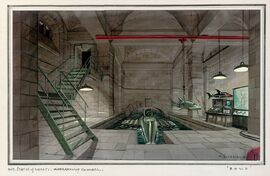
Warhead (1978) concept artwork - interior of the Statue of Liberty depicting docking chamber with a submarine, and a robot 'Hammerhead' shark hanging.
In the mid-1970s McClory again started working on a projection to bring a Thunderball accommodation to product and, with the working title Warhead, he brought writer Len Deighton together with Sean Connery to work on a script.[6] The script ran into difficulties after accusations from Eon Productions that the project had gone across copyright restrictions, which confined McClory to a film based on the Thunderball novel simply, and over again the projection was deferred.[5]
Towards the end of the 1970s developments were reported on the project under the name James Bail of the Surreptitious Service,[5] but when producer Jack Schwartzman became involved and cleared a number of the legal issues that still surrounded the projection[one] he brought on lath scriptwriter Lorenzo Semple, Jr.[7] to work on the screenplay. Connery was unhappy with some aspects of the piece of work and asked Tom Mankiewicz, who had rewritten Diamonds Are Forever, to work on the script; however Mankiewicz declined as he felt he was under a moral obligation to Cubby Broccoli.[8] Connery and so hired British television writers Dick Clement and Ian La Frenais[9] to undertake re-writes, although they went uncredited for their efforts because of a restriction by the Writers Social club of America.[6]
The film underwent i last change in title: afterwards Connery had finished filming Diamonds Are Forever he had pledged that he would "never" play Bond again.[6] Connery's wife, Micheline, suggested the title Never Say Never Once again, referring to her husband'due south vow[10] and the producers best-selling her contribution by listing on the end credits "Title "Never Say Never Over again" by: Micheline Connery". A concluding effort past Fleming'southward trustees to block the moving-picture show was made in the High Courtroom in London in the spring of 1983, simply this was thrown out past the court and Never Say Never Once more was permitted to proceed.[5]
Bandage and crew
When producer Kevin McClory had outset planned the pic in 1964 he held initial talks with Richard Burton for the part of Bail,[xi] although the project came to goose egg because of the legal issues involved. When the Warhead project was launched in the late 1970s, a number of actors were mentioned in the trade press, including Orson Welles for the part of Blofeld, Trevor Howard to play M and Richard Attenborough as director.[6]
In 1978 the working title James Bond of the Hugger-mugger Service was being used and Connery was in the frame in one case once more, potentially going head-to-caput with the next Eon Bond film, Moonraker.[12] Past 1980, with legal bug again causing the project to founder,[6] Connery thought himself unlikely to play the role, equally he stated in an interview in the Sunday Express: "when I kickoff worked on the script with Len I had no thought of actually being in the film".[13] When producer Jack Schwartzman became involved, he asked Connery to play Bail; Connery agreed, asking (and getting) a fee of $3 million, ($7 meg in 2016 dollars) a percentage of the profits, as well as casting and script approving.[6] Subsequent to Connery reprising the role, the script has several references to Bond's advancing years – playing on Connery existence 52 at the time of filming[6] – and academic Jeremy Black has pointed out that at that place are other aspects of age and disillusionment in the moving picture, such every bit the Shrubland's porter referring to Bond's auto ("They don't make them like that anymore."), the new M having no employ for the 00 department and Q with his reduced budgets.[xiv]
For the chief villain in the picture, Maximillian Largo, Connery suggested Klaus Maria Brandauer, the lead of the 1981 Academy Laurels-winning Hungarian film Mephisto.[7] Through the same road came Max von Sydow every bit Ernst Stavro Blofeld,[15] although he still retained his Eon-originated white true cat in the film.[16] For the femme fatale, director Irvin Kershner selected former model and Playboy cover girl Barbara Carrera to play Fatima Chroma – the name coming from i of the early scripts of Thunderball.[6] Carrera'due south functioning as Fatima Chroma earned her a Gilt Globe Honour nomination for Best Supporting Extra,[17] which she lost to Cher for her role in Silkwood.[18] Micheline Connery, Sean's married woman, had met up-and-coming actress Kim Basinger at a hotel in London and suggested her to Connery, which he agreed upon.[6] For the role of Felix Leiter, Connery spoke with Bernie Casey, proverb that as the Leiter role was never remembered by audiences, using a black Leiter might make him more memorable.[vii] Others cast included comedian Rowan Atkinson, who would later parody Bond in his role of Johnny English.[nineteen]
Old Eon Productions' editor and director of On Her Majesty's Secret Service, Peter R. Hunt, was approached to direct the moving-picture show simply declined due to his previous work with Eon.[20] Irvin Kershner, who had achieved success in 1980 with The Empire Strikes Back was then hired. A number of the coiffure from the 1981 film Raiders of the Lost Ark were also appointed, including first banana managing director David Tomblin, director of photography Douglas Slocombe and production designers Philip Harrison and Stephen Grimes.[7] [15]
Filming
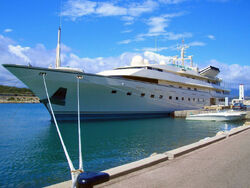
The Kingdom 5KR which acted every bit Largo's ship, the Flying Saucer
Filming for Never Say Never Again began on 27 September 1982 on the French Riviera for two months[vi] before moving to Nassau, the Commonwealth of the bahamas in mid-November[7] where filming took place at Clifton Pier, which was besides i of the locations used in Thunderball.[6] The Spanish city of Almería was besides used every bit a location.[21] Largo's Palmyran fortress was actually historic Fort Carré in Antibes.[22] For Largo'south ship, the Flying Saucer, the yacht Nabila, owned past Saudi billionaire, Adnan Khashoggi, was used. The boat, now endemic by Prince Al-Waleed bin Talal, has afterward been renamed the Kingdom 5KR.[23] Master photography finished at Elstree Studios where interior shots were filmed.[half-dozen] Elstree also housed the Tears of Allah underwater cavern, which took iii months to construct.[6] Most of the filming was completed in the leap of 1983, although there was some additional shooting during the summertime of 1983.[7]
Production on the picture show was troubled,[xv] with Connery taking on many of the production duties with assistant director David Tomblin.[six] Director Irvin Kershner was critical of producer Jack Schwartzman, proverb that whilst he was a skilful businessman, "he didn't accept the experience of a picture producer".[6] Later on the production ran out of money, Schwartzman had to fund further product out of his ain pocket and later admitted he had underestimated the amount the motion picture would cost to make.[15]
Steven Seagal, who was the fight choreographer for this film, broke Connery's wrist while grooming. On an episode of The Tonight Evidence with Jay Leno, Connery revealed he did not know his wrist was broken until over a decade later.[24]
Many of the elements of the Eon-produced Bond films were non present in Never Say Never Again for legal reasons. These included the gun barrel sequence, where a screen full of 007 symbols appeared instead, and similarly there was no "James Bail Theme" to use, although no try was fabricated to supply another melody.[7] A pre-credits sequence was filmed only not used;[15] instead the moving-picture show opens with the credits run over the top of the opening sequence of Bond on a training mission.[6]
Music
The music for Never Say Never Again was written by Michel Legrand, who equanimous a score similar to his work equally a jazz pianist.[25] The score has been criticised as "anachronistic and misjudged",[6] "bizarrely intermittent"[15] and "the most disappointing feature of the moving-picture show".[7] Legrand also wrote the chief theme "Never Say Never Again", which featured lyrics by Alan and Marilyn Bergman—who had as well worked with Legrand in the University Award winning song, "The Windmills of Your Mind"[26]—and was performed by Lani Hall[vii] after Bonnie Tyler, who disliked the song, had reluctantly declined.[27]
Phyllis Hyman too recorded a potential theme vocal, written past Stephen Forsyth and Jim Ryan, but the song—an unsolicited submission—was passed over given Legrand'south contractual obligations with the music.[28]
Cast and Characters
Crew
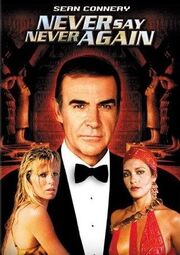
MGM DVD cover.
- Directed by: Irvin Kershner
- Screenplay by: Lorenzo Semple Jr.
- Produced by: Jack Schwartzman, Kevin McClory (executive), Michael Dryhurst (acquaintance)
- Cinematography by Douglas Slocombe
- Music composed by: Michel Legrand
Comic Adaptation
Argentinean publisher Editora Columba, who published several original Castilian-language James Bond moving-picture show adaptations in diverse D'artagnan comic magazines during the '60s and '70s, adapted Never Say Never Once more in 1984.
Images
Trivia
- This is the only Bond film to be directed by an American. The moving picture's manager, Irvin Kershner, had previously directed Sean Connery in A Fine Madness.
- The moving picture title comes from Sean Connery'southward statement when asked if he would always play Bond again after Diamonds Are Forever, to which he replied "Never Once again".
- The Flying Saucer, Largo'southward ship, is a translation of "the Disco Volante", the name of Largo's send in Thunderball. In this film, the Disco Volante is a formidable vessel conspicuously based on a armed services cruiser hull, with a helipad and calibration which dramatically dwarf the vessel present in the official film continuity. The Disco is still the base of underwater operations past Largo. In real life, the ship used in long shots was known equally the "Nabila" and was built for Saudi billionaire, Adnan Kashoggi.
- The casino where Bond and Largo go caput to head in a videogame was called Casino Royale.
- This scene too prevented author John Gardner from having a somewhat similar scene involving Bail playing a computer game over a LAN in Gardner'southward novel Part of Accolade. Bond was supposed to be playing a simulation of "The Battle of Waterloo", this was later changed to a unlike type of game involving "The Battle of Bunker Hill". Interestingly, the Battle of Waterloo would likewise play a office in the after official Bond film, The Living Daylights.
- Originally, both this film and Octopussy were to be released to theatres simultaneously, which led to a cursory flurry of media activity regarding the "Battle of the Bonds". Ultimately, it was decided to carve up the two release dates.
- McClory originally planned for the film to open with some version of the famous "gunbarrel" opening as seen in the official Bond series, just ultimately the pic opens with a screenful of "007" symbols instead. When the soundtrack for the film was released on CD, it included a slice of music equanimous for the proposed opening.
- Klaus Maria Brandauer, who played Largo, was originally bandage as Marko Ramius in The Hunt for Ruby October; the role eventually went to Connery.
- Rowan Atkinson made his motion-picture show debut in this picture show. Atkinson, who later became famous for the Mr. Bean comedy serial, played a British agent in this picture show, the bungling Nigel Minor-Fawcett. Later he would play a James Bond parody in Johnny English.
Come across also
- The controversy over Thunderball.
References
- ↑ 1.0 ane.ane Pfeiffer, Lee; Worrall, Dave (1998). The Essential Bail. London: Boxtree Ltd, p.213. ISBN 978-0-7522-2477-0.
- ↑ 2.0 two.1 Poliakoff, Keith (2000). "License to Copyright – The Ongoing Dispute Over the Ownership of James Bond". Cardozo Arts & Amusement Law Journal 18: 387–436. Benjamin N. Cardozo School of Law. Retrieved on three September 2011. Cite error: Invalid
<ref>tag; name "Poliakoff (2000)" divers multiple times with different content - ↑ 3.0 iii.1 Chancellor, Henry (2005). James Bail: The Human being and His Earth. London: John Murray, pp.226. ISBN 978-0-7195-6815-two.
- ↑ 4.0 four.one Macintyre, Ben (2008). For Yours Eyes Only. London: Bloomsbury Publishing, p.198-99. ISBN 978-0-7475-9527-4.
- ↑ 5.0 5.one 5.2 5.3 Chapman, James (2009). Licence to Thrill: A Cultural History of the James Bail Films. New York: I.B. Tauris, p.184. ISBN 978-1-84511-515-ix.
- ↑ half dozen.00 six.01 6.02 6.03 6.04 6.05 half-dozen.06 vi.07 6.08 vi.09 six.x half dozen.eleven vi.12 6.thirteen 6.14 6.15 6.16 Barnes, Alan; Hearn, Marcus (2001). Osculation Kiss Blindside! Bang!: the Unofficial James Bond Film Companion. Batsford Books, pp.152-56. ISBN 978-0-7134-8182-2.
- ↑ 7.0 7.i vii.2 7.iii 7.four vii.5 vii.half dozen 7.seven vii.viii Benson, Raymond (1988). The James Bond Bedside Companion. London: Boxtree Ltd, p.240-43. ISBN 1-85283-234-seven.
- ↑ Mankiewicz, Tom; Crane, Robert (2012). My Life as a Mankiewicz. Lexington, KY: University Press of Kentucky, p.150. ISBN 978-0-8131-3605-nine.
- ↑ La Frenais, Ian (1936–) and Clement, Dick (1937–). Screenonline. British Film Institute. Retrieved on three September 2011.
- ↑ Dick, Sandra. "Fourscore big facts you must know about Big Tam", 25 August 2010, p. 20.
- ↑ "A Rival 007 – Information technology Looks Similar Burton", 21 February 1964, p. 13.
- ↑ Davis, Victor. "Bond versus Bond", 29 July 1978, p. 4.
- ↑ Isle of man, Roderick. "Why Sean won't now exist back equally 007 ...", 23 March 1980, p. 23.
- ↑ Black, Jeremy (2005). The Politics of James Bond: from Fleming's Novel to the Big Screen. University of Nebraska Press, p.58. ISBN 978-0-8032-6240-nine.
- ↑ xv.0 15.1 15.2 15.iii xv.iv xv.five Smith, Jim (2002). Bond Films. London: Virgin Books, pp.193-99. ISBN 978-0-7535-0709-4.
- ↑ Chapman, James (2009). Licence to Thrill: A Cultural History of the James Bail Films. New York: I.B. Tauris, p.135. ISBN 978-one-84511-515-9.
- ↑ Barbara Carrera. Official Golden Globe Award Website. Hollywood Foreign Press Association. Retrieved on 2 September 2011.
- ↑ Best Operation by an Actress in a Supporting Part in a Motion Flick. Official Golden Globe Award Website. Hollywood Foreign Printing Clan. Retrieved on 3 September 2011.
- ↑ Johnny English. Penguin Readers Factsheets (2003). Retrieved on five September 2011.
- ↑ "Director Peter Hunt – "On Her Majesty's Undercover Service"", Retrovision. Retrieved on five September 2011.
- ↑ Armstrong, Vic (7 May 2011). I'one thousand the real Indiana (when I'm not decorated being James Bail or Superman). Daily Mail.
- ↑ Reeves, Tony (2001). The Worldwide Guide to Picture show Locations. Chicago: A Cappella, p.134. ISBN 978-1-55652-432-5.
- ↑ Salmans, Sandra. "Lavish Lifestyle of a Wheeler-Dealer", 22 February 1985. Retrieved on half-dozen September 2011.
- ↑ Kurchak, Sarah (12 October 2015). Did Steven Seagal Break Sean Connery's Wrist with Aikido?. Vice.com. Retrieved on 24 November 2015.
- ↑ Bettencourt, Scott (1998). "Bond Back in Action Again". Film score monthly .
- ↑ Error on phone call to Template:cite spider web: Parameters url and title must be specified. University of Movie Arts and Sciences.
- ↑ The Bat Segundo Testify: Bonnie Tyler (12 September 2008). Tyler also discusses this in the documentary James Bond's Greatest Hits.
- ↑ Burlingame, Jon (2012). The Music of James Bond. Oxford: Oxford University Printing, p.112. ISBN 978-0-19-986330-3.
External links
- Never Say Never Again (1983) at IMDb
- MGM'south page on the moving picture
| James Bond films |
|---|
| Sean Connery Dr. No (1962) • From Russia with Love (1963) • Goldfinger (1964) • Thunderball (1965) • You Only Live Twice (1967) • Diamonds are Forever (1971) |
| George Lazenby On Her Majesty's Hush-hush Service (1969) |
| Roger Moore Live and Allow Die (1973) • The Human with the Golden Gun (1974) • The Spy Who Loved Me (1977) • Moonraker (1979) • For Your Eyes But (1981) • Octopussy (1983) • A View to a Kill (1985) |
| Timothy Dalton The Living Daylights (1987) • Licence to Kill (1989) |
| Pierce Brosnan GoldenEye (1995) • Tomorrow Never Dies (1997) • The Globe Is Non Enough (1999) • Die Another Day (2002) |
| Daniel Craig Casino Royale (2006) • Quantum of Solace (2008) • Skyfall (2012) • Spectre (2015) • No Time To Die (2021) |
| Unofficial films Casino Royale (1954) • Casino Royale (1967) • Never Say Never Again (1983) |
Source: https://jamesbond.fandom.com/wiki/Never_Say_Never_Again_(film)

Post a Comment for "Never Say Never Again Bond Girl"